
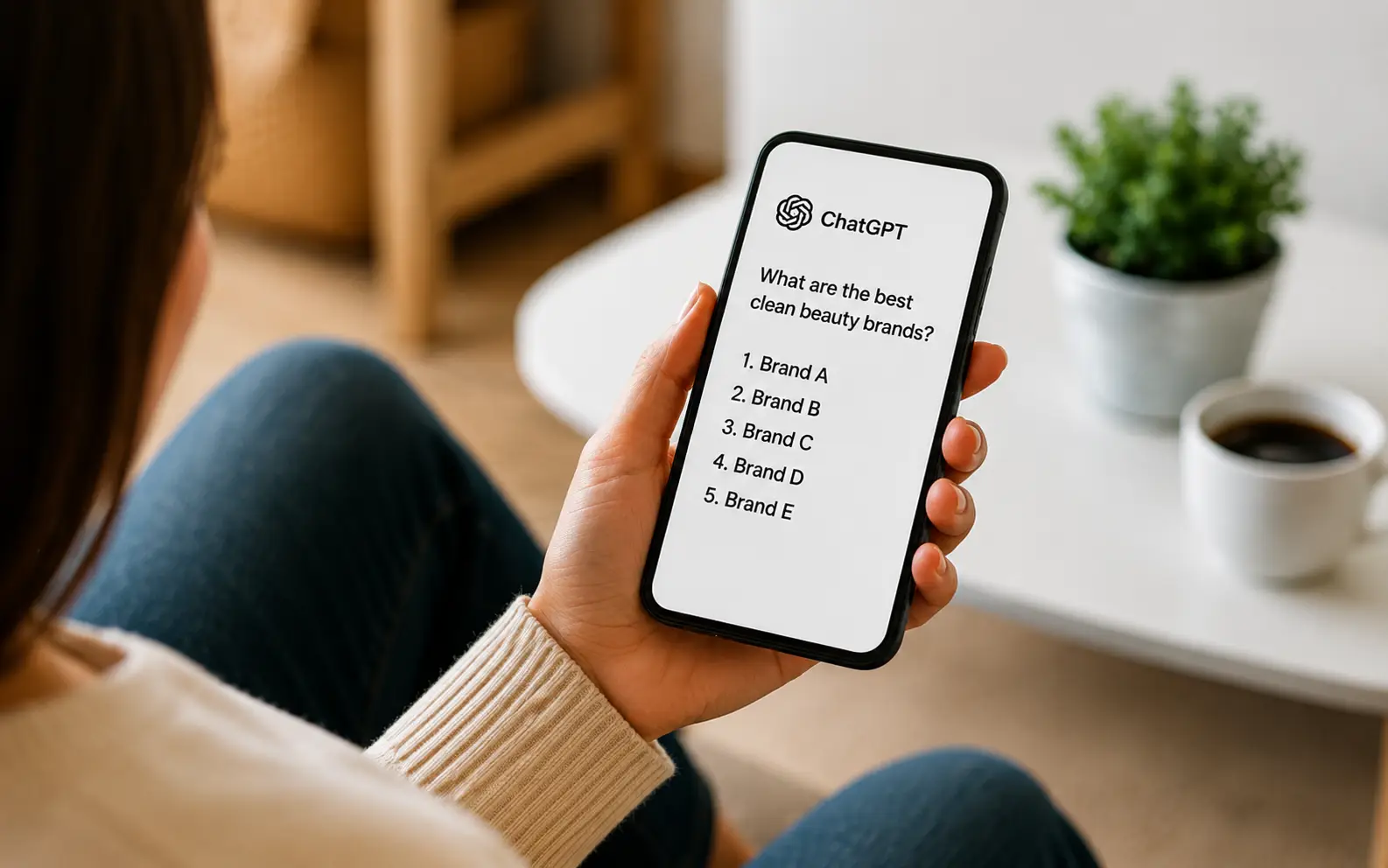
AI recommends brands it finds discussed across trusted third-party sources, not brands with the strongest SEO. Editorial coverage, product reviews, affiliate buying guides, retailer pages, and community discussion are what large language models pull from. Ranking first on Google matters less than being named in many places at once.
I have a version of this conversation almost every week now. Somewhere in the middle of a discovery call a founder pulls up ChatGPT on her phone, types something like “best vitamin C serum for sensitive skin,” and reads me the five brands that come back. Hers isn’t one of them.
Then comes the question I hear more than any other right now, usually asked with a fair amount of frustration, because on paper she’s doing everything right. Her site ranks well, her ads work, her reviews are strong. So why is AI handing her customer five competitors instead of her.
The answer turns out to be simpler than most founders expect, and it has almost nothing to do with her website.
What Founders Are Seeing When AI Starts Recommending Their Brand
What Changes First Is Lead Quality, Not Lead Volume
The founders and marketing directors who have crossed over into being recommended tend to describe the change in almost identical terms, and it isn’t the change you’d expect. Lead volume doesn’t always jump. What shifts is who’s showing up.
Prospects arrive already sold. They skip the education phase entirely, they ask fewer basic questions, and they come in knowing what the product is for and whether it’s for them.
There’s a reason those leads arrive warmer, and it has nothing to do with AI. The 2026 Edelman Trust Barometer surveyed 17,688 people across 15 countries and found that what unpaid third parties say about a brand carries far more weight than anything the brand says about itself, with consumers placing the most weight on unpaid advocates, customers, and peers. Trust now rates as a purchase criterion for 88% of them, which puts it effectively level with quality at 89% and value at 88%.
An AI recommendation is that same third-party voice, only it arrives at the exact moment someone is choosing. That’s earned credibility showing up as an answer.
AI-Referred Traffic Converts Better Than Search Traffic
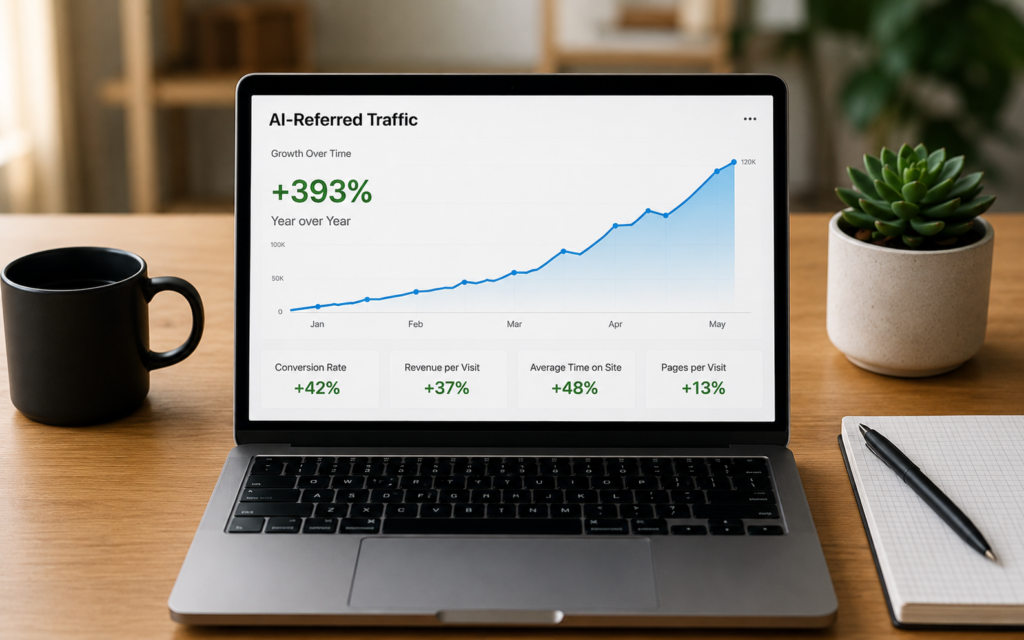
The numbers back up what those founders feel. Adobe Analytics found that in March 2026, AI-referred traffic to US retail sites converted 42% better than non-AI traffic, a record high and a full reversal from a year earlier when it converted worse. Those same shoppers spent 48% more time on site, viewed 13% more pages per visit, and produced 37% higher revenue per visit.
Volume is climbing too. AI-referred traffic to retail sites grew 393% year over year in the first quarter of 2026, and more than doubled again in May.
For premium beauty and wellness, where trust is doing most of the work in the purchase decision, that shift matters even more. A recommendation from an AI assistant reads to the shopper as a neutral third party who already did the homework for her, so she doesn’t go check the sources. She just buys.
AI doesn’t read your website and decide you’re credible. It reads what everyone else says about you.
Why AI Recommends Some Brands and Not Others
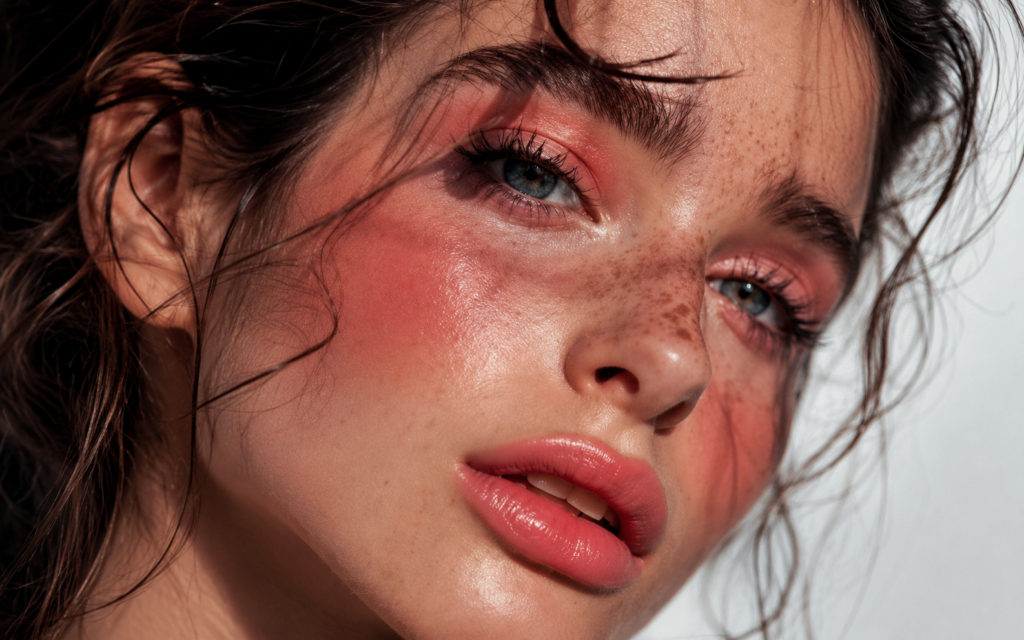
LLMs, Large Language Models, don’t rank pages the way a search engine does, they synthesize. When a shopper asks for the best clean deodorant, the model pulls together what it can find across a wide range of sources and builds a single answer out of where those sources agree. The brands that turn up in more of them are the brands that get named.
That’s why strong SEO on its own stops being enough. A 2025 arXiv study of generative search found that AI search shows a systematic bias toward earned media, meaning third-party authoritative sources, over both brand-owned and social content. Google spreads its results across a more balanced mix of sources, and AI search doesn’t.
Edelman reached the same place from the other direction. Its 2026 brand playbook tells companies to lead with earned and scale with paid, and to make those proof points discoverable in LLM-driven search.
The founding academic work on this points the same direction. In GEO: Generative Engine Optimization, presented at ACM SIGKDD in 2024, researchers tested roughly 10,000 queries and found that adding statistics, quotations from credible sources, and cited sources raised a page’s visibility in AI answers by over 40%. Keyword density, by contrast, barely moved the needle.
The most useful finding in that paper is buried in the tables. Pages sitting mid-page in Google gained more AI visibility from citing their sources than the top-ranked page did, and the top-ranked page actually lost share. Traditional search rewards backlinks, which tends to favor whoever has been around longest. Generative engines read the content itself, which is how a smaller brand can beat an incumbent inside an AI answer without ever outranking it on Google.
Multiple Reddit users testing AI recommendations have landed on the same observation independently. One summarized an experiment by noting that the same four to six brands dominated almost every response, and some of them weren’t even ranking first on Google.
A page sitting fifth in Google gained 115.1% more AI visibility just by citing its sources. The page ranked first lost 30.3%.
Here’s where those sources actually live.
The Sources AI Actually Cites for Beauty, Fashion, Wellness & Home Brands
This is where it gets specific, and specific is the part you can actually act on.
Novi, a beauty product data platform, analyzed 10.7 million citations that ChatGPT referenced between January 22 and May 20, 2026, spanning more than 98,000 source websites. Global Cosmetic Industry reported the findings, and they’re blunt. Across beauty queries overall, Reddit was the most-cited source by a wide margin, followed by Who What Wear, Wikipedia, Sephora, and Allure.
Break it down by category and the picture gets sharper still. For skin care questions, the top five cited sources were Reddit, Who What Wear, Sephora, Allure, and Ulta Beauty. For fragrance, it was Reddit, Wikipedia, Who What Wear, Fragrantica, and Sephora.
Reddit tops both lists, and it’s the one layer no brand can buy or manage its way into. Everything underneath it, though, is earnable. Who What Wear, Allure, Sephora, and Ulta are all reachable through editorial and retailer work, and they’re the sources sitting right beside Reddit inside the same answer.
The same study found that 73% of shoppers now use AI search tools to learn about products and brands, while nearly half of brands, 47%, still aren’t sure whether or how their products show up in AI answers.
The brand-level data shows who’s already winning this. Glossy reported that The Ordinary tops beauty brands in AI citations, appearing in 7% of responses to beauty prompts across ChatGPT, Claude, and Perplexity, and that Charlotte Tilbury leads makeup brands at 4.5%.
Here is how the layers stack up, and who actually controls each one.
| Source layer | What it looks like | How AI reads it | Who controls it |
|---|---|---|---|
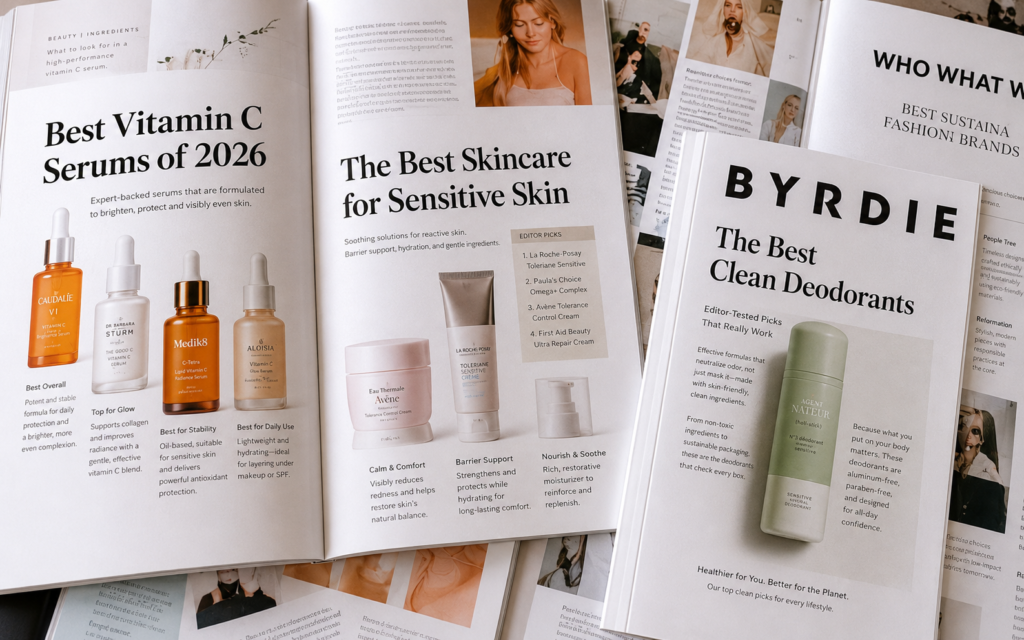
| Editorial | Allure, Byrdie, Who What Wear roundups | Independent validation | Earned, through PR |
| Affiliate and buying guides | Ranked “best X for Y” articles | A recommendation already made | Earned through PR & Affiliate |
| Retailer pages | Sephora, Ulta, Amazon listings | Product facts and review depth | Shared with the retailer |
| Community | Reddit threads, review sections | Real customer consensus | Earnable, never buyable |
| Creator | YouTube reviews, long-form demos | Demonstrated use | Earned through PR seeding |
| Brand-owned | Your site, blog, and product pages | Baseline facts, lowest weight | Fully yours |
Look down the right-hand column. Five of those six layers sit somewhere other than your website, which is usually where most of a brand’s effort is going. We wrote about the upstream version of this pattern in how consumers discover beauty brands, and AI recommendation is now the layer sitting on top of it.
Affiliate Buying Guides Are Doing the Heaviest Lifting
If there’s one format worth fighting for right now, it’s the ranked roundup.
Wix Studio’s AI Search Lab analyzed 75,000 AI answers and more than a million citations across ChatGPT, Google AI Mode, and Perplexity. As Search Engine Land reported, listicles took 21.9% of all citations, the largest share of any page type, and captured roughly 40% of commercial-intent citations, nearly double any other format. Query intent predicted citations better than industry or which model you were optimizing for.
Now think about what a “best clean shampoo for color-treated hair” article actually is. It’s an affiliate roundup. Which means affiliate commerce isn’t sitting off to the side of a visibility strategy anymore, it’s producing the exact pages AI reaches for at the moment a shopper is ready to choose.
That’s a big part of why Push The Envelope builds affiliate into placement work instead of treating it as a separate line item. Across our verified January 2025 to May 2026 client data, affiliate-driven revenue rose 62%. Those same placements are the pages AI cites.
Earn the roundup and you get paid twice, once on the click and once on the citation.
How Push The Envelope Clients Are Getting Recommended by AI
Our AI Discoverability service starts from a position that hasn’t changed much since we opened in 2006, which is that earned coverage across trusted sources is what builds credibility. What’s changed is that a machine now reads all of that coverage and turns it into a recommendation.
So the work runs in three parts.
We test the prompts your buyer actually types. Not the keywords you wish you owned, but the real questions, run across ChatGPT, Claude, Perplexity, Gemini, and Google AI Overviews. The answers differ enough by engine that testing only one tells you almost nothing.
We map the citation gap. For every prompt we record which sources the engine pulled from, which gives us a target list of the specific outlets, roundups, retailer pages, and communities already shaping answers in your category, along with a clear view of which ones you’re missing from.
We go earn placement in those sources. We aim at the outlets already being cited in your category rather than the ones that simply look impressive in a report. Our product placement work is where most of this lands.
We hold a 97% client retention rate, and I think the reason is that clients can see the connection between a placement and a sale. That’s the same argument I made in modern PR isn’t just press, and AI recommendation has made it easier to prove, not harder.
The impact becomes clear when you look at the authority signals AI systems rely on.
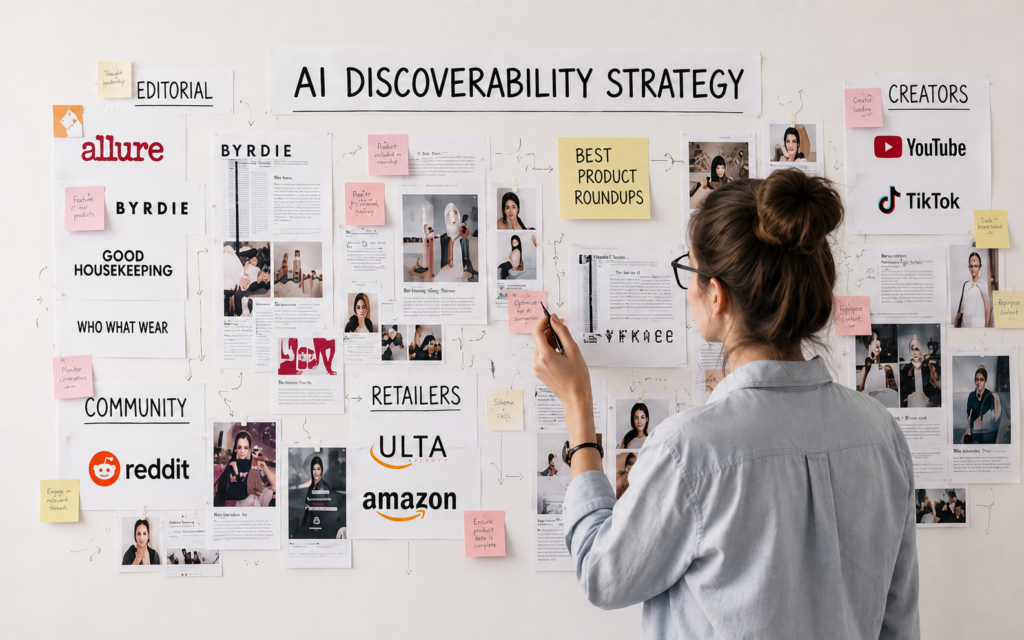
Lilyeve and Korean Haircare Queries
Take Lilyeve, one of Push The Envelope’s K-beauty clients. Consumers are increasingly asking AI engines questions like “What is the best Korean haircare for thinning hair?”, “What is the best Korean scalp treatment for dandruff?”, “What is the best Korean haircare brand on Amazon?”, and “What is the best Korean hair treatment for damaged hair?” Today, those answers are heavily influenced by the beauty publications AI trusts most, including Allure, Byrdie, Good Housekeeping, Who What Wear, and retailer authority like Sephora. Rather than chasing vanity coverage, our strategy is to earn placements in the editorial roundups, product reviews, affiliate commerce stories, and expert recommendations that already shape AI-generated answers. As those independent citations accumulate, brands like Lilyeve build the authority signals that increase their likelihood of being surfaced for recommendation-driven queries. That’s the difference between simply selling on Amazon and becoming a brand AI has enough third-party evidence to recommend.
We’ve seen the same principle play out across multiple categories.
Timeless Skin Care and Vitamin C Serum Recommendations
For Timeless Skin Care, we focused on recommendation-driven skincare queries such as “What is the best affordable vitamin C serum?” and “What is a good alternative to SkinCeuticals C E Ferulic?” After earning editorial coverage in Real Simple and InStyle, Timeless gained additional high-authority validation tied directly to those searches. Instead of AI relying primarily on the brand’s website or Amazon listing, it now has trusted editorial publications independently recommending the product, strengthening Timeless’ authority for recommendation-style queries.
Printfresh and Best Pajamas Roundups
The pattern extends well beyond beauty. Printfresh earned placement in Good Housekeeping’s roundup of the best women’s pajamas, creating another authoritative source AI references when consumers ask questions like “What are the best cotton pajamas?” or “What are the best luxury pajamas for women?” Rather than competing solely through ecommerce listings, Printfresh now benefits from independent editorial validation that reinforces its expertise within the category.
Where to Start if AI Isn’t Naming You Yet
Four things, in this order.
Run the audit yourself this week. Write down the ten questions a real buyer would ask before choosing in your category, then run each one through ChatGPT and Perplexity and log both which brands come back and which sources the answer cites. That gives you a target list, and it costs you about an hour.
Check that AI crawlers can read your site. If your robots.txt blocks AI crawlers, or your product pages bury their facts inside images and scripts, none of the earned coverage will do as much for you as it should. Ingredients, use cases, testing, and certifications all need to be in plain text.
Go where the citations already are. Your audit hands you a list of the exact publications and pages shaping answers in your category. Those are your targets. Editorial coverage, product reviews, and affiliate roundups in those specific outlets do more for AI recommendation than a bigger campaign in outlets nobody is citing.
Track recommendation, not rank. There’s no number one position to win in ChatGPT. Research from SparkToro, cited by Ahrefs, found that asking it the same question 100 times gives you under a 1 in 100 chance of getting the same brand list twice. What you can measure is how often you show up across a fixed set of prompts, and whether that share is climbing.
Start with the audit. Everything else follows from what it shows you.

Ready to Find Out What AI Says About Your Brand?
We’ll start by running your category’s real buying questions across five AI engines, look at which brands are being recommended, which sources those answers are pulling from, and where your brand is missing from the picture. Then we’ll use Push The Envelope’s internal tools and proprietary AI project to map out how we can increase your AI Discoverability.
Talk to us about AI Discoverability →
If Amazon is your primary revenue channel, how PR drives sales for Amazon brands covers how the upstream discovery layer feeds it.
Frequently Asked Questions
Why does AI recommend some brands and not others?
AI assistants build recommendations by synthesizing many sources rather than ranking pages. Brands mentioned consistently across editorial coverage, product reviews, buying guides, retailer pages, and community discussion get named most often. A 2025 arXiv study of generative search found AI systematically favors third-party earned sources over brand-owned content.
Can you rank number one in ChatGPT?
No. There is no fixed ranking. Research from SparkToro found that asking ChatGPT the same question 100 times gives under a 1 in 100 chance of the same brand list appearing twice. The measurable goal is recommendation frequency, meaning how often your brand appears across a set of relevant prompts.
Does SEO still matter for AI recommendations?
Yes, but it isn’t sufficient on its own. Pages usually need to be retrievable before they can be cited. The KDD 2024 GEO study found keyword density had minimal effect on citations, while statistics, quotations from credible sources, and cited sources raised visibility by over 40%.
What sources does ChatGPT cite for beauty product recommendations?
Novi’s analysis of 10.7 million ChatGPT citations found Reddit was the most-cited source across beauty queries by a wide margin, followed by Who What Wear, Wikipedia, Sephora, and Allure.
Do affiliate articles help a brand get recommended by AI?
Substantially. Wix Studio’s AI Search Lab found ranked listicles took 21.9% of all AI citations and around 40% of commercial-intent citations, more than any other page type. Most “best product for X” roundups are affiliate content, which makes affiliate placement one of the highest-return routes into AI recommendations.
Does AI-referred traffic actually convert?
Adobe Analytics found that AI-referred traffic to US retail sites converted 42% better than non-AI traffic in March 2026, with 37% higher revenue per visit and 48% more time spent on site. Volume is still a small share of total traffic, but quality per visit is higher.
How do you measure whether AI is recommending your brand?
Build a fixed set of prompts your buyers would actually type, run them across ChatGPT, Claude, Perplexity, Gemini, and Google AI Overviews on a regular schedule, and record three things each time: whether your brand was recommended, whether it was only mentioned, and which sources the engine cited. Tracking that share over time is the metric.