

No. AI can draft press releases, research journalists, and write pitches in seconds. It cannot earn the placement. AI depends on that human work: Muck Rack’s May 2026 study of 25 million AI citations found 84% came from earned media and 0.3% from paid content.
I get this question on almost every discovery call now: Can AI replace PR? And it usually comes from a founder who’s already experimented with AI for PR. They uploaded their brand story into ChatGPT, generated what looked like a great press release, emailed it to dozens of editors, and nothing happened.
The AI did exactly what it was supposed to do. But the pitch didn’t.
Here’s what it looks like when a pitch does land. After we secured a Wirecutter placement for one of our skincare clients, the brand sold more than 600 units on Amazon within 24 hours of the story going live. That didn’t happen because we relied on an AI press release. It happened because our pitch met the content need of the right editor who believed the product belonged in the story and recommended it to millions of readers.
If you’re wondering whether AI can replace your PR agency, that’s the difference you need to understand before making that decision.
AI Is Changing Marketing Faster Than Any Technology We’ve Seen
Yes. AI is incredibly capable, and pretending otherwise could leave you behind. We use AI every single day at Push The Envelope PR. It helps us research journalists faster, summarize interviews, brainstorm campaign ideas, organize media lists, and create stronger first drafts in a fraction of the time it used to take. It has fundamentally changed the way we work, and I think every business should be using it.
For a founder running a beauty, fashion or lifestyle brand, that’s a huge advantage. AI has made quality marketing content faster, more accessible, and more affordable than ever before. If you’re not using it on the backend of your business, you’re missing an opportunity.
Where founders get into trouble is assuming that because AI can produce the deliverable, it can produce the result.
PR Was Never Really About the Writing
Most founders think PR is about writing press releases. That’s why so many assume AI can replace it. The truth is, writing is only a small part of what we actually do. The other ninety percent is understanding what editors are already working on, positioning your brand in a way that naturally fits those conversations, category expertise deep enough to know that a clean beauty editor and a prestige beauty editor need two completely different angles for the same serum, and building relationships over years so your email actually gets opened.
Then there’s everything people never see. It’s coaching a founder before a live TV interview, recognizing that a competitor’s placement just opened the door for your brand, knowing an editor changed beats last month or that a publication is quietly rebuilding its commerce team. It’s understanding that the same beauty product might need one angle for Allure and a completely different one for Forbes. None of that comes from a prompt. It comes from experience.
Cision’s State of the Media Report puts numbers behind the problem. Most journalists receive 50 or more pitches a week, and 72% say fewer than a quarter of those are relevant to what they cover. Untargeted outreach is the single biggest frustration in media relations, and the people who break through are the ones bringing something specific, whether that’s data, original research, an exclusive, but most importantly, timely content that fits within the editor’s story. This is why mass pitching rarely works.
Editors aren’t looking for more emails. They’re looking for ideas that fit the stories they’re already working on.
AI has made it easier than ever to send hundreds of pitches. It hasn’t made it any easier to send the right one.
Editors Don’t Publish Press Releases
Founders spend a lot of time trying to write the perfect press release, but the reality is that editors aren’t looking for press releases. They’re looking for stories. A press release tells your story. An editor is looking for a story their readers will actually care about. Sometimes those two things overlap, but not nearly as often as founders think.
When I look back at the placements that have made the biggest impact for our clients, very few started with a press release. They started with a trend an editor was already covering, a founder with a unique perspective, or a product that genuinely fit the conversation. That’s where the real work of PR happens. There is a distinct difference between generating content vs earning credibility. AI can absolutely help you write a press release. It can even help you draft a pitch. What it still can’t do is build the trust that makes an editor open your email, believe your recommendation, and ultimately decide your brand belongs in their story.
AI Doesn’t Build Trust, Editors Do

Consumers trust publications like Forbes, Allure, People, TODAY, and Business Insider because they trust the people behind those publications to make thoughtful recommendations. When an editor includes a product in a story, they’re putting their own credibility behind it. That’s very different from a brand talking about itself.
If anything, AI makes that human trust even more valuable. As AI-generated content floods the internet, people are looking for signals they can trust. That’s one of the reasons earned media matters more today than it did five years ago. A recommendation from a respected publication carries weight because someone made a decision to include your brand. AI can’t manufacture that kind of credibility. This matters more now, not less. Edelman’s Trust Barometer has tracked declining trust in institutions for years while showing that people still rely on credible third parties over brand self-description. And the Reuters Institute Digital News Report has found real audience discomfort with news produced mainly by AI. As AI-written content floods the internet, human-verified coverage becomes rarer and worth more.
There’s a business and return benefit to consider also, and it’s the part I care most about. Affiliate and commerce placements, the shoppable roundups where a reader clicks through and buys, are assigned by commerce editors who are judged on conversion. They put products in those pieces because they believe the product will perform and because they trust the person who brought it to them. Across our client work from January 2025 through May 2026, brands running affiliate commerce alongside earned coverage saw a 62% average increase in affiliate-driven revenue. Not one of those placements came from an automated pitch.
That’s why relationships still matter.
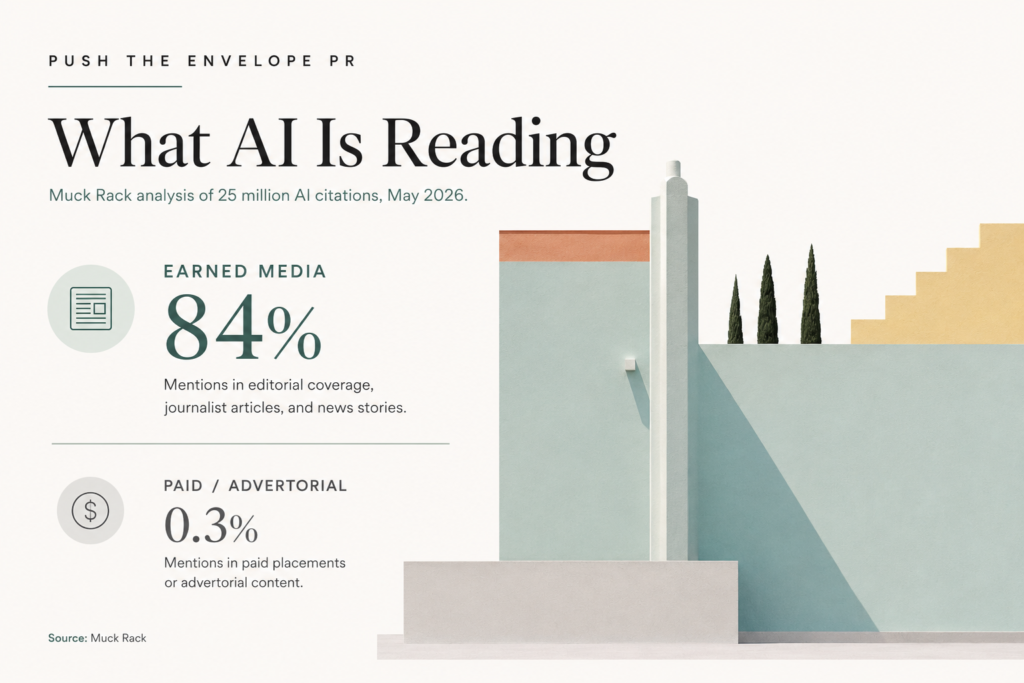
What AI Is Reading: 84% of Citations Come From Earned Media
What AI Is Reading: 84% of Citations Come From Earned Media “If your brand is not showing up in the media coverage AI is reading, you are not showing up in the answers AI is giving,” said Greg Galant, cofounder and CEO of Muck Rack. “That is a visibility problem with real business consequences.”
When people ask whether AI can replace PR, I think they’re asking the wrong question.
A better question is: What Is AI Reading?
Tools like ChatGPT, Google’s AI Overviews, Claude, Perplexity, and other large language models don’t invent recommendations out of thin air. They look for information that’s already been published by credible sources. They learn from articles, reviews, expert commentary, product roundups, interviews, and trusted editorial coverage that already exists online.
Muck Rack’s study, published May 7, 2026, analyzed more than 25 million links inside ChatGPT, Claude, and Gemini answers across 17 industries. Earned media accounted for 84% of every citation. Paid and advertorial content only accounted for 0.3%.
This is why earned media is more important than ever for beauty, fashion, lifestyle and consumer brands. When a shopper asks ChatGPT which retinol is worth buying, the answer is being assembled almost entirely out of editorial coverage. Paid placement is close to invisible in that process.
The practice of influencing this has a name now, Generative Engine Optimization, or GEO. It sits next to SEO but runs on different fuel. Search rewards keywords, backlinks, and on-page structure. AI rewards credibility signals, and those signals come from coverage you earned rather than coverage you bought.
What makes the finding hard to dismiss is how steady it has been. Across all three editions of the study going back to July 2025, earned media has ranged from 82% to 89%. That consistency suggests this isn’t a quirk of one model update, it’s how these systems have settled on sourcing information.
“If your brand is not showing up in the media coverage AI is reading, you are not showing up in the answers AI is giving,” said Greg Galant, cofounder and CEO of Muck Rack. “That is a visibility problem with real business consequences.”
Every credible article about your brand becomes another signal that helps establish authority, not just with consumers, but with the AI systems they’re increasingly relying on to answer questions and make purchasing decisions.
We’re already seeing this shift with our own clients. The brands that consistently earn quality editorial coverage tend to have a stronger digital footprint overall because that coverage doesn’t disappear after it’s published. It continues working long after the initial article goes live, influencing search results, AI-generated answers, and future discovery.
That’s why we don’t think about PR as simply generating press anymore. We think about it as building a body of credible, third-party content that keeps working for your business long after the original placement.
The future isn’t AI or PR. It’s AI fueled by credible PR.
How We Use AI at Push The Envelope PR

The best PR teams aren’t competing with AI, they’re using it. AI has become an incredible productivity tool, and we use it every day. But the parts of PR that actually move a business forward, judgment, relationships, timing, credibility, and strategy, are still deeply human. That’s not a limitation of AI. It’s simply the nature of how trust is built.
We have built internal AI agents and AI projects to analyze trends and search data across beauty, fashion, lifestyle and wellness so we know what is rising before it peaks. We use it to research journalists at speed, pulling a writer’s last two years of coverage into a summary in minutes instead of an afternoon. We use it to pressure-test pitch angles, generating twenty options so our team can strategically throw out nineteen. We use it to structure content for AI discoverability, because a growing share of buyers now ask ChatGPT and Perplexity for product recommendations before they ever open Google. We track which outlets the models are citing in our clients’ categories, then aim earned coverage at those outlets on purpose rather than by accident. And we use it to sharpen SEO on client-facing assets so earned coverage keeps working long after publication.
Push The Envelope PR works with beauty, fashion, wellness, grooming, home, and travel brands, and the pattern holds across all of them. What we don’t hand to AI is the relationship, the judgment call, or the final word to an editor. Those stay with people who have been doing this since 2006.
That split is why our client retention sits at 97% on an average monthly retainer of $5,000. Founders aren’t paying us for words. Words are close to free now. They are paying for the decisions, and for the phone being answered on the other end.
If you want to see what that looks like in practice, our work on product placement and gifting programs is the clearest example. AI helps us target it. Humans close it.
The Future Is AI Plus Human Relationships

The brands winning right now are leveraging both, AI and AI-savvy PR agencies. The citation data settles the argument in a way I didn’t expect when I started tracking it.
AI systems are not competing with earned media, they are running on it.
Every ChatGPT answer that recommends a moisturizer is quietly dependent on an editor having made a decision about that moisturizer first. Cutting your earned media spend to save money on PR now means removing yourself from the source material AI reads.
Worth knowing on the search side too: Google has been explicit that it rewards helpful, quality content regardless of how it was produced, while treating AI content built purely to manipulate rankings as spam. The same logic applies to media. Nobody objects to AI helping you prepare. Everybody objects to AI-generated noise sent at scale.
When to Use AI and When to Bring in a Human
| Use AI when you need to | Bring in people when you need to |
| Create a strong first draft you’ll refine yourself | Earn media coverage, partnerships, or affiliate placements |
| Research a market, competitor, or journalist | Position your brand in a competitive market |
| Brainstorm ideas or prepare for an interview | Protect your reputation during interviews, launches, or sensitive announcements |
| Organize information and save time on repetitive tasks | Navigate situations where relationships, judgment, and experience determine the outcome |
A founder we work with was offered a national morning show segment with 36 hours’ notice. AI couldn’t have prepped her wardrobe, tightened her three talking points, or called the producer to confirm the product angle. That took people.

Getting Started: What to Do With This If You’re Deciding Right Now
If you’re trying to decide whether to invest in AI, hire an agency, or do a little of both, here’s the advice I’d give any founder.
- Look closely at what you’re paying for. If most of the work you’re receiving is content creation, research, or documents, AI can probably handle a good portion of that today. If you’re paying for relationships, strategic guidance, and earned media placements, that’s a very different investment.
- Use AI to make your team more efficient, not to replace expertise. Let it help with research, first drafts, brainstorming, and repetitive tasks so your people can spend more time on the work that actually moves your business forward.
- Measure business results, not just media coverage. The best PR programs don’t stop at securing placements. They help build authority, increase discoverability, and, when appropriate, drive affiliate revenue and sales. Coverage should support your business goals, not just fill a monthly report.
- Give your strategy enough time to work. Whether you’re using AI, an agency, or a combination of both, define one or two meaningful metrics and evaluate them over a full quarter. That gives you a much clearer picture of whether your challenge is a production problem, a visibility problem, or a relationship problem.
At the end of the day, this isn’t really a decision between AI and PR. It’s a decision about where technology creates efficiency and where people create value. The brands that understand the difference are the ones that will have the strongest competitive advantage over the next few years.
Build a Visibility Program for Your Beauty, Fashion, or Wellness Brand
We use AI every day at Push The Envelope PR, and we wouldn’t want to work without it. It helps us move faster, uncover better insights, and spend more time on the work that actually creates results for our clients.
What hasn’t changed is how meaningful media coverage is earned. It still comes down to strong stories, thoughtful strategy, and relationships with editors who trust the people pitching them.
If you’re a beauty, fashion, wellness, or lifestyle founder thinking about where to invest your visibility budget next, I’d encourage you to start building that foundation sooner rather than later. Earned media compounds over time. Every quality placement strengthens your credibility, expands your digital footprint, and creates another opportunity for customers, and increasingly AI, to discover your brand.
Talk through your visibility plan with our team contact now.
And if you’d like to dive deeper into how PR is evolving, be sure to read Modern PR Is Not Just Press Releases and How Coverage Drives Sales for Amazon Brands. They build on many of the ideas we’ve covered here and take a closer look at where the industry is headed.
Frequently Asked Questions
u003cstrongu003eCan AI replace a PR agency?u003c/strongu003e
No. AI can replace the production work inside PR, including drafting releases, summarizing interviews, and researching journalists. It can’t replace the editor relationships, category judgment, and timing that determine whether a brand gets published. Most brands get the best result by using AI for preparation and people for placement.
u003cstrongu003eCan AI write a press release that editors will publish?u003c/strongu003e
AI can write a technically clean press release, but editors rarely publish press releases at all. They publish stories, news, data, and insights brought to them by someone they trust. The document isn’t the obstacle, the relationship and the angle are.
u003cstrongu003eWill AI-written content hurt my Google rankings?u003c/strongu003e
Not by itself. Google has stated it rewards helpful, high-quality content regardless of how it was produced, while treating AI content created mainly to manipulate rankings as spam. The risk is publishing unedited, generic AI output at volume, which tends to lack the original experience signals both Google and AI search reward.
u003cstrongu003eHow much does a PR retainer cost compared with AI tools?u003c/strongu003e
AI tools typically run $20 to $200 a month for content production. A performance-led PR retainer sits far higher, with our own average at $5,000 a month across January 2025 to May 2026. The two aren’t competing purchases. One produces assets, the other produces placements and affiliate revenue.
u003cstrongu003eHow do brands get cited in ChatGPT, Claude, and Gemini answers?u003c/strongu003e
Through earned media, primarily. Muck Rack’s May 2026 analysis of 25 million AI citations found 84% came from earned media and only 0.3% from paid or advertorial content. The practical route is coverage in outlets those platforms already cite in your category.
u003cstrongu003eWhich PR tasks should beauty and wellness founders automate with AI?u003c/strongu003e
Automate first drafts, research summaries, competitor tracking, journalist background research, and repurposing existing content across channels. Keep human control over positioning decisions, pitch targeting, editor communication, crisis response, and anything involving a live appearance.
u003cstrongu003eDoes AI help or hurt affiliate and commerce placements?u003c/strongu003e
It helps with the preparation and hurts if used to pitch. Commerce editors select products they believe will convert, and they rely on people they trust to bring them. AI is useful for identifying target publications and tracking performance, while the placement itself still comes down to a relationship and a track record.